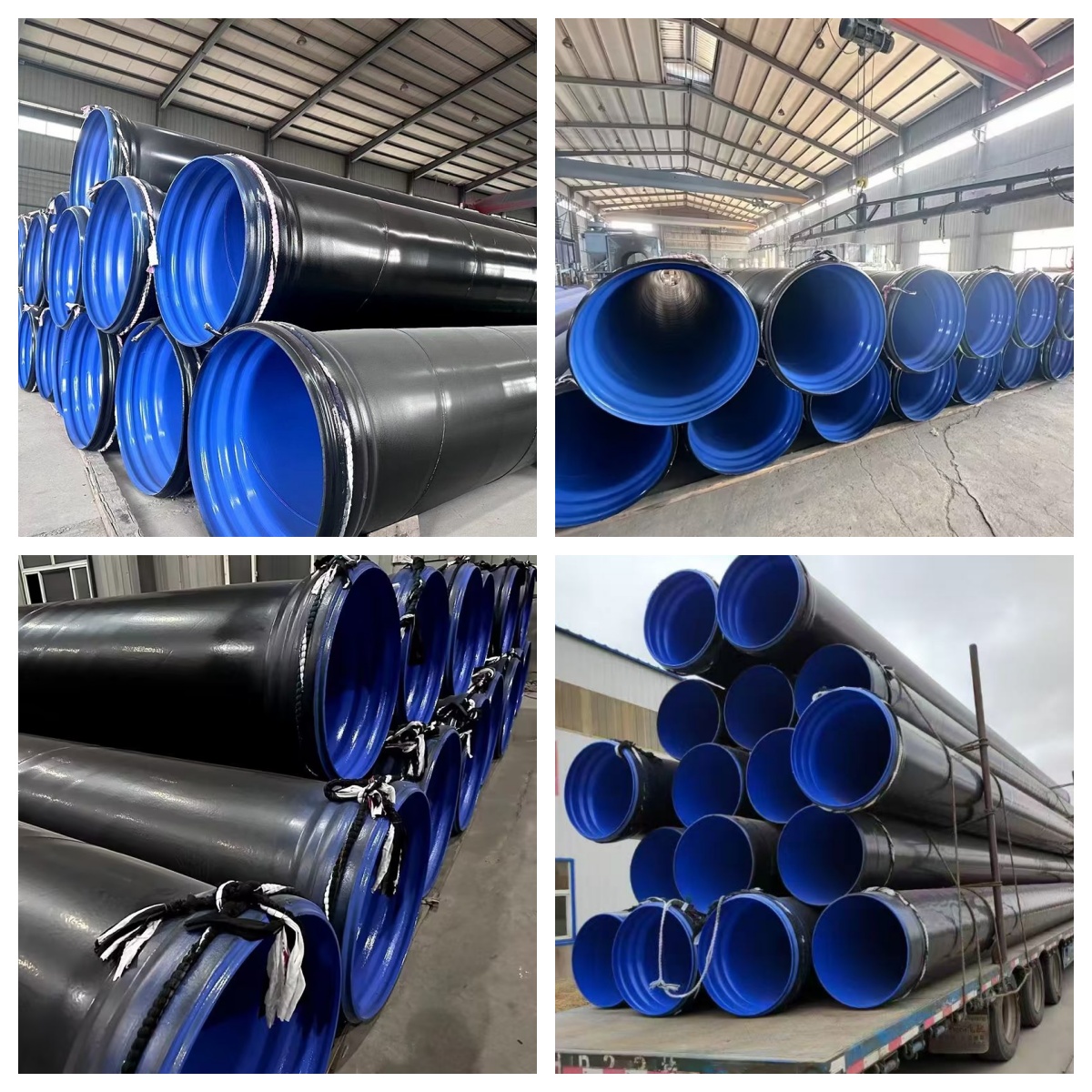
Socket Steel Pipe ManufacturerWhat is a socket steel pipe? Socket steel pipe is a type of pipe in which a steel pipe is joined to another steel pipe or fitting using a specific connection method. Its core working principle is to insert one end of the steel pipe into the socket of the other end, and then ensure the sealing and stability of the connection through sealing materials, sealing rings, or welding.
 Classification of Socket Steel Pipes
Based on different application scenarios and connection processes, socket steel pipes can be mainly classified into the following categories:
Based on different application scenarios and connection processes, socket steel pipes can be mainly classified into the following categories:
1. Socket Plastic Coated Steel Pipes: This type of pipe is commonly used in water supply, drainage, gas, and fire protection piping systems. It involves coating the inner and outer surfaces of the steel pipe with anti-corrosion materials such as epoxy resin to form a protective layer that effectively prevents corrosion and extends service life. Compared to welding and threaded connections, its socket-type connection design offers better sealing, shock resistance, and installation flexibility, effectively reducing the risk of leakage.
2. Buried Socket Steel Pipes: This type of steel pipe is commonly used in underground water, gas, and oil transportation projects. To adapt to the underground environment, it typically has multiple anti-corrosion coatings (such as polyurethane coating, galvanized layer, phenolic epoxy coating, etc.) and a cathodic protection layer. Internally, rubber pads and buffer components are installed to absorb the impact force during drainage, preventing pipe wear and significantly extending service life.
3. Socket Welded Steel Pipes: This belongs to high-pressure pipeline connection fittings and is typically used for small-diameter pipes of 2 inches and below. During connection, the pipe is inserted into the wall of the valve or fitting and welded using fillet welds. This method eliminates the need for pre-beveling the pipe, making installation convenient and effectively preventing weld slag from leaking into the pipe and causing blockages. It is commonly used in industrial settings requiring high structural strength and leak-proofness, such as petrochemical, power, and nuclear power industries.
4. Socket Steel Pipe Scaffolding
This is a support structure used in the construction industry, an upgraded product of coupler-type and cup-lock scaffolding. It uses cast steel welded plugs and sockets as connectors, with Q235 steel pipes as the main components. This type of scaffolding has self-locking capabilities, is flexible and quick to assemble and disassemble, and has good mechanical strength and stability. It is widely used in building formwork engineering, exterior wall scaffolding, and temporary stage construction.
5. Socket Sonic Logging Pipe
This is a type of pipe used for pile foundation testing (such as a 54mm outer diameter socket-type 54mm sonic logging pipe). It utilizes the propagation characteristics of sound waves in materials to detect defects such as voids and cracks inside the pile foundation. Its socket joint design ensures a tight connection between pipes, providing excellent sealing and effectively preventing grout leakage and water seepage.
Product Parameters
| Nominal Diameter/ mm |
Inner Coating Layer /mm |
Outer coating layer,mm |
| Ordinary level |
Strengthen level |
| DN ≤65 |
>0.3 |
>0.6 |
>0.8 |
| 65≤DN≤150 |
>0.35 |
>0.8 |
>1.0 |
| 150≤DN≤300 |
>0.35 |
>0.8 |
>1.2 |
| 300≤DN≤800 |
>0.4 |
>1.0 |
>1.3 |
| 800≤DN≤1200 |
>0.45 |
>1.2 |
>1.8 |
| 1200≤DN≤3600 |
>0.45 |
>1.5 |
>1.8 |
Advantages of Socket Steel Pipes
1. Highly Efficient Construction, Significantly Shortened Construction Period
Socket steel pipes utilize an "instant insertion and stability" design, eliminating cumbersome welding procedures. Installation requires no professional welders; ordinary workers can operate the system, and installation speed can be increased several times, even tenfold. This simple and quick process greatly accelerates project progress, making it particularly suitable for water conservancy and municipal pipeline projects requiring rapid progress.
2. Lower Overall Costs
Because it eliminates the need for professional welders and expensive jointing materials, socket steel pipe connections significantly reduce labor and material costs. For example, in the construction of pipelines of specific diameters, the overall cost can be reduced to a fraction of that of traditional methods. Furthermore, the cost of subsequent maintenance and replacement can be reduced by more than 30%, resulting in outstanding long-term economic benefits.
3. Superior Seismic and Settlement Resistance
Traditional welding is a rigid interface that cannot effectively release stress; while socket-type connections are flexible interfaces, allowing the pipeline to deflect within a certain angle (e.g., 1°30′-3°30′). This design transforms pipelines from "fracture-prone long beams" into "bending-resistant chain-like components," effectively adapting to soil settlement and complex terrain, and offering excellent seismic performance.
4. Superior Corrosion Resistance and Long Service Life: Socket connections do not damage the original anti-corrosion layer during installation, eliminating the hassle of secondary repairs and avoiding quality defects such as incomplete coating and uneven thickness caused by difficulties in repairing the inner weld wall. This ensures long-term corrosion protection for the pipeline system, with a service life typically exceeding 50 years.
5. Construction Safety and Fire Risk Mitigation: Socket connections eliminate the need for on-site hot work or the use of hazardous materials such as acetylene, preventing fire hazards at the source. Simultaneously, the ease of operation reduces worker workload by more than 50%, minimizing quality issues caused by fatigue and making the construction process safer and more reliable.
6. Excellent Sealing and Strong Adaptability: Socket joints are typically used with rubber sealing rings, providing excellent sealing performance and effectively preventing water and air leaks. At the same time, it is suitable for various working conditions and pipe diameters, and has strong adaptability in complex scenarios such as water supply and drainage, heating, gas supply, petrochemicals, and special pressure pipelines.


